What Is a Moving Hoist? Window and Balcony Lifts Explained
What do you do when a sofa measures wider than the stairwell it has to climb? Most people try the same things in the same order. They tilt it, twist it, take off the legs, and then stand on the landing wondering whether the piece was ever meant to go upstairs.
When none of that works, someone usually mentions a hoist. It sounds like specialist equipment, and it is. This primer explains what a hoist is, when one gets considered, and what has to be sorted out before anyone sets one up. The short version: a hoist is a last-resort way to get a large item into or out of a building. It needs measurements, permissions and a trained crew. Local permit and building rules differ, so every rule mentioned below should be confirmed with your building and your city.
Why Some Items Cannot Take the Stairs
Buildings are designed around people, not around the furniture people eventually buy. A stairwell has a fixed width, and every turn and landing has a fixed amount of room. A door that works well for a person can be too narrow for a wardrobe or a large sectional.
Several things commonly cause trouble:
- Tight turns. A long piece may clear the straight sections of a staircase but jam at a corner, where its length needs more room than the landing offers.
- Low ceilings and stair headroom. An item can fit sideways on the flat and still catch the ceiling as the stairs rise.
- Small or shared elevators. Interior size, door width and weight rules all limit what rides up.
- Older buildings. Narrow doorways and winding stairs were built long before oversized furniture was common.
- Large items bought online. A sofa that looked fine in a showroom photo may never have been checked against your hallway.
Often, the item got in once, before a wall was added or a door frame was updated. Sometimes it never fit and nobody checked. When a piece will not go through the front, the question becomes whether it can go around the front.
What a Hoist Is and How It Works
A hoist is a piece of lifting equipment that moves items up or down the outside of a building instead of through its interior. The setup varies by provider and by job, so treat the description below as general rather than as a specification.
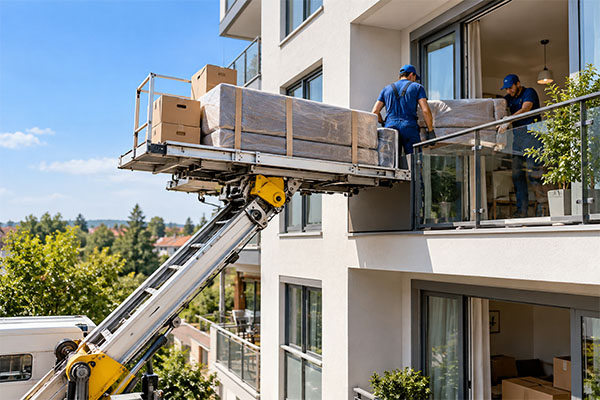
In a common arrangement, a ladder-style frame or rail is set up against the exterior wall. A powered platform or carriage travels along it, carrying the item to a window or balcony opening. A crew at the bottom loads the platform, and a crew at the top receives the item and brings it inside. Taking things out of a building reverses the process.
Other approaches exist too, such as a crane or boom attached to a truck. Which one fits depends on the building, the item, the street and the opening it has to reach.
Two points are worth keeping in mind. First, a hoist delivers an item to an opening, not to a final room. The window or balcony door still has to be big enough for the piece, and the route inside still matters. Second, running a hoist is a trained skill. It is not a rental you set up over a weekend, and the planning around it matters as much as the machine.
When a Hoist Is Considered (Measurements First)
Nobody should start with the hoist. Start with a tape measure.
Measure the item in all three dimensions: height, width and depth. Then measure the route it needs to travel. That includes door widths, stairwell widths, the turn clearance on each landing, ceiling heights along the stairs, and the inside of the elevator if there is one. Measure the destination opening as well. For a window, that means the clear space once the sash and any screen are removed, not the outside frame.
Write the numbers down and compare them. If the item clears every point with room to spare, you probably do not need a hoist. If it fails at one point and nothing can be done about it, a hoist becomes a realistic option. Upper floors raise the odds, since there are more stairs, more turns and fewer ways around.
Some providers offer this work as its own service, and one Philadelphia mover’s home page lists Hoisting Services among its options. That is useful to know when you are searching, because it shows how the work is usually named and that it may be booked separately from a standard move. Search terms like “window hoist” or “furniture lift for a balcony” may also turn up providers who describe it differently.
Balconies deserve extra care. A balcony can be a convenient landing point, but it was built to hold people and a few chairs, not necessarily a loaded piece of furniture and a crew. Ask the building’s management, and the provider, what the balcony can take. Do not assume it works.
Building, Street and Permit Rules (Verify With the Building and the City)
This is the part many households skip, and it is where plans get derailed. A hoist uses space outside your front door that you may not control.
Start with the building. Landlords, condo boards and property managers often have rules about move days, elevator reservations and exterior work. Some will want to approve a hoist in advance. Some require proof of insurance from the provider, and some limit the hours when work is allowed. If the plan involves removing a window or screen, ask whether the lease or building rules allow it and who handles the removal and reinstallation.
Then look at the street. Equipment and trucks may take up parking spaces, part of a sidewalk or a traffic lane. Many cities require a permit or notice for that kind of occupancy, and the rules differ by city, sometimes by neighborhood. In a place like Philadelphia, check with the city’s permitting offices about whether a street or sidewalk permit applies. This article cannot tell you what your block requires, and a provider’s description of local rules is not a substitute for confirming them yourself.
Also look up. Overhead utility lines, trees and awnings can limit where equipment can stand. Historic districts and some co-ops add their own restrictions. A quick call to the building manager, followed by the city, is much cheaper than a canceled job on the day.
Weather, Timing and Safety Planning
Outdoor lifting depends on the weather. Strong wind, rain, ice and extreme heat can all affect whether a crew will proceed. Ask the provider how it handles bad conditions and whether it offers a backup date. Winter and summer scheduling also affects building availability, since many buildings limit how many moves can happen at once.
Timing matters inside the building too. Elevator reservations, access to the apartment and the arrival of both a hoist crew and a standard moving crew all need to line up. Book the opening of the day carefully, so the item is not waiting outdoors while other work catches up.
On safety, the useful questions are procedural. Ask who sets up the equipment, how the area below is kept clear, and what training the crew has. A reputable provider can describe its process in plain language. This article makes no claim about outcomes, and no setup removes risk entirely. That is why the crew’s training and the building’s approval carry so much weight.
Alternatives to Try First
Because a hoist adds cost, scheduling and permission steps, other options deserve a fair look before booking one:
- Legs, arms, headboards, cushions, shelves and doors often come off. Many large pieces are designed to be taken apart, and the manufacturer’s instructions may show how.
- A different entrance. A back door, a side entry, a ground-floor window or a service entrance may be wider than the front.
- A freight or service elevator. Some buildings have a larger lift that residents can reserve.
- Changing the item. If a piece truly cannot fit, selling it or donating it and buying something modular may cost less than the lift.
- Checking before buying. For future purchases, measure the delivery route first, not just the room where the item will sit.
A hoist makes sense when those options have been tried or ruled out, and the piece matters enough to justify the extra work.
Questions to Ask a Provider
If a hoist still looks like the right answer, these questions help you compare providers and avoid surprises:
- Do you offer hoisting directly, and is it priced separately from the move?
- What equipment do you use, and can it reach my floor and my type of opening?
- Who handles building approvals and any required permits?
- Can you provide proof of insurance to my building?
- What is your process for bad weather and rescheduling?
- Who removes and reinstalls windows or screens, if that is required?
- Can you visit or review photos before quoting?
Their answers will tell you how experienced they are with this work. Vague replies, or reluctance to discuss permits and insurance, are worth noting.
Planning for the Piece That Will Not Fit
A hoist is a clever solution to a narrow problem. It earns its place when an item cannot take the stairs or the elevator, the building allows exterior work, and a trained crew can handle the setup. Before it gets that far, measurements and a few honest alternatives usually settle the question.
If you do go forward, treat the planning as part of the job. Confirm the rules with your building and your city, check the weather plan with the provider, and make sure everyone involved agrees on the route before the day begins. A little preparation keeps the equipment from becoming the most stressful part of the move.
Most Popular Post
-
October 28, 2026
What Is a Moving Hoist? Window and Balcony Lifts Explained -

-

-